New scoping study maps the needs of communication and swallowing professionals in low- and middle-resourced countries

IALP has published the findings of a scoping study into the working lives of logopedists, speech and language therapists/pathologists, phoniatricians, and audiologists in low- and middle-resourced countries. The study was conducted by North Peak Insights (Miriam Antcliffe and Caroline Dix) with Professor Sue Roulstone of UWE Bristol, and led for IALP by President Elect Kamini Gadhok MBE.

An online survey, translated into multiple languages, received 140 eligible responses from 38 countries, with 46 languages or dialects reported in professional practice. Most respondents were clinicians working in health services, and many worked across more than one sector.

Respondents were clear about their priorities: support to carry out research (88%); access to documents that support clinical practice (86%); and opportunities to work with health or education groups on national guidelines and policies (84%). There was strong interest in international conferences, online mentoring, and global working groups, but less appetite for setting up new local associations – and a clear preference for strengthening existing degree programmes rather than creating new ones.

Four themes ran through the open responses: advocacy, standardisation, training and research, and equity. Respondents asked for genuine partnership that recognises local expertise, rather than models of practice imported from elsewhere. The findings will inform IALP’s strategy for supporting these professionals and, ultimately, the people they work with.

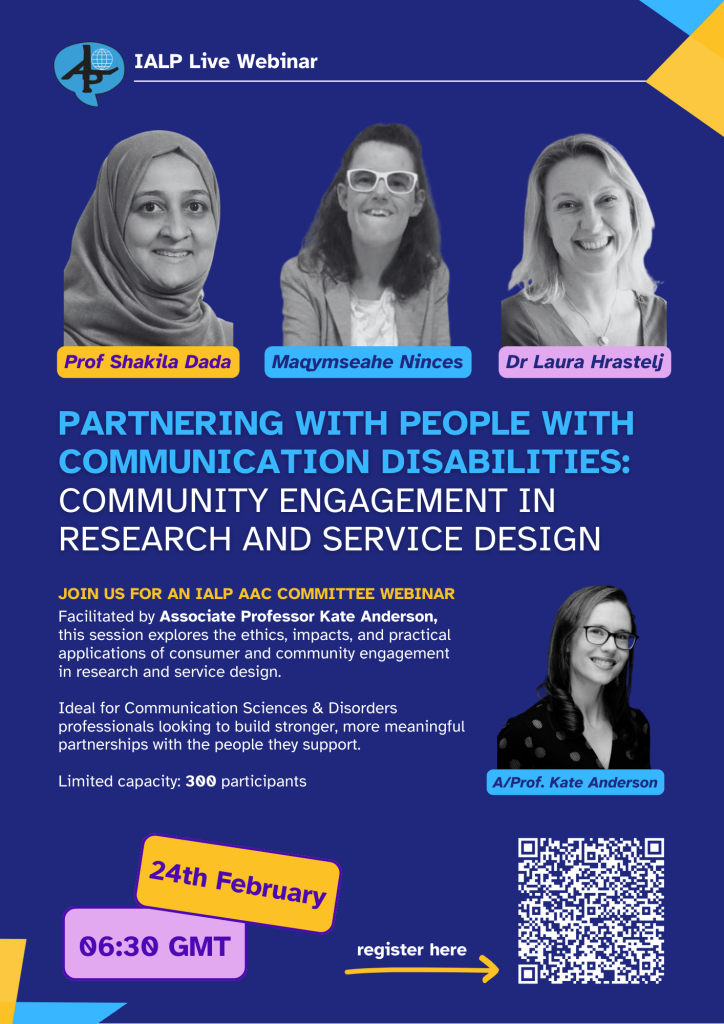
Upcoming IALP AAC Committee Webinar: Partnering with People with Communication Disabilities: Community Engagement in Research and Service Design

The Augmentative and Alternative Communication (AAC) Committee of the International Association of Communication Sciences and Disorders (IALP) is proud to present this live webinar.

Speakers: Prof. Shakila Dada, Maqymseahe Ninces, Dr. Laura Hrastelj

Facilitated by: Associate Professor Kate Anderson

Description: How can clinicians, researchers, and service providers meaningfully partner with people with communication disabilities to shape the research and services that impact their lives?

This interactive session explores the ethics, benefits, and real-world applications of consumer and community engagement. Drawing on established guidelines and illustrated through participatory projects involving children and adults with complex communication needs, it offers practical insights and strategies.

The webinar includes short applied activities and plenty of time for questions and discussion. All specialisms in communication sciences and disorders are welcome—ideal for anyone committed to building stronger, more inclusive partnerships.

Date & Time: Monday, 24 February 2026 06:30 GMT (UTC); 17:30 Melbourne, Australia (AEDT); 07:30 CET

Limited capacity: 300 participants – register early!

Scan the QR code on the attached flyer to secure your spot!